Ningaloo Coast, Western Australia
Ningaloo Coast, Western Australia
Status: needs expert review. Figures below cite UNESCO and Australian/WA government sources; a reviewer should confirm currency and add specific marine-park zoning rules before approval. Ningaloo is one of the longest near-shore reefs in the world and the site of the largest documented whale shark aggregation.
Overview
The Ningaloo Coast, on the remote western coast of Australia near Exmouth, was inscribed on the UNESCO World Heritage List in 2011 as a ~604,500-hectare marine and terrestrial property. It includes Ningaloo Marine Park (extending up to ~22 km offshore), Cape Range National Park, the Muiron Islands, and the Bundegi and Jurabi coastal parks. It is managed by the Western Australian Department of Biodiversity, Conservation and Attractions (DBCA).
Marine life to know
Ningaloo supports high marine diversity: more than 300 documented coral species, over 700 reef fish species, and hundreds of mollusc, crustacean, and marine-algae species. Its signature visitor is the whale shark (Rhincodon typus) — see the species page. An estimated 300–500 whale sharks aggregate here annually, coinciding with mass coral spawning and seasonal nutrient upwelling — the largest documented aggregation of the species in the world.
Ecosystems
A long fringing reef close to shore, backed by the arid Cape Range. The closeness of deep water to the reef drives the productivity that brings whale sharks and other megafauna near the coast.
Protections and regulations
The area is a UNESCO World Heritage property and a state marine park. Whale shark and other megafauna interactions at Ningaloo are a licensed, regulated tourism activity. This briefing does not provide approach guidance — consult DBCA's marine-park rules and licensed-operator conditions, which set minimum distances, no-touch rules, swimmer numbers, and seasonal limits. A reviewer should add the specific current marine-park zoning and interaction regulations with citations.
Organizations and how to engage
- Managed by DBCA (Western Australia).
- Reef-health citizen science via programs such as Reef Check.
- Log marine sightings to a recognized platform (see the iNaturalist dataset card).
Seasonal calendar
- March–August: whale shark season (peak following mass coral spawning).
- Coral spawning and humpback migration are additional seasonal events; confirm exact timing locally.
- Avoid disturbing any aggregation; if your presence changes animal behavior, withdraw.
Sources (3)
Every claim traces to one of the citations below. Anything that could not be sourced was left out.
Related in the commons
Ethical Whale Shark Observation at Ningaloo (with a licensed operator)
Join a licensed whale shark tour at Ningaloo Marine Park during the season and observe the world's largest fish without disturbing it — then contribute your observation to citizen science. This is a beginner friendly in
Monterey Bay Marine Briefing
Monterey Bay is one of the most ecologically diverse marine regions in the world. Dominated by the massive underwater Monterey Canyon, which rivals the Grand Canyon in depth and scale, the bay brings cold, nutrient rich
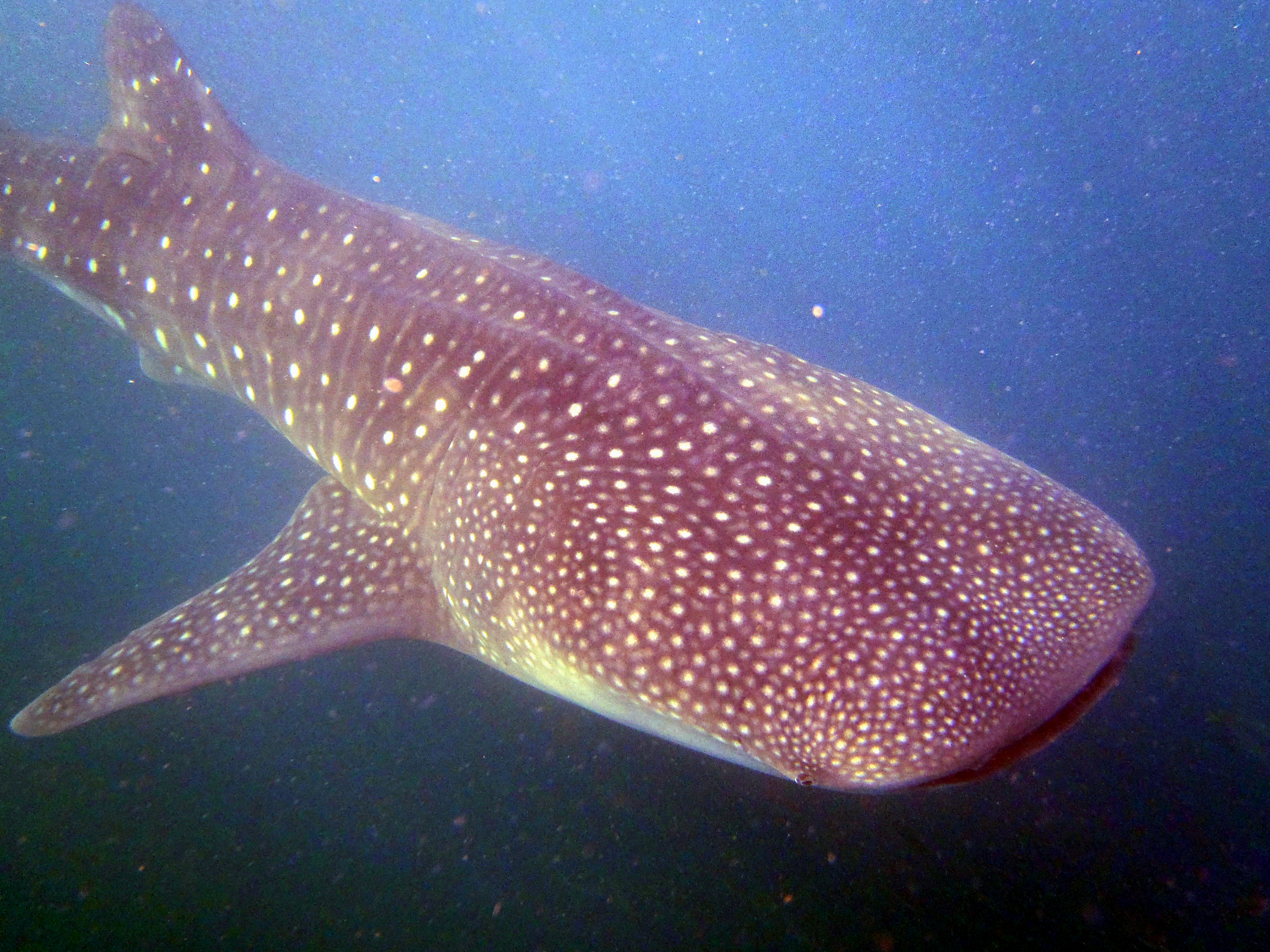
Image: cotterillmike / CC0
Whale Shark (Rhincodon typus)
The whale shark is unmistakable: a very large shark (the largest fish species), dark grey above with a distinctive pattern of pale spots and stripes, a broad flattened head, and a huge terminal mouth used for filter feed
Galápagos Marine Reserve, Ecuador
The Galápagos Marine Reserve is one of the largest marine protected areas in the world, surrounding the Galápagos Islands roughly 1,000 km off the coast of Ecuador. The reserve was created by Ecuador in 1998 and covers o